
Church food pantries and donation drives often depend on rotating volunteers, short receiving windows, and food arriving from several sources at once. That generosity is easier to manage when every donated package follows the same documented path from intake to shelving. A recall check can be one part of that path, alongside the pantry’s existing rules for donation eligibility, package condition, date labels, allergens, and temperature control.
The routine below is an operational framework, not a substitute for a food bank’s requirements or state and local health guidance. Pantry leaders should adapt it to their written policy, assign who can make hold-or-release decisions, and train volunteers on the version their program actually uses. That planning fits naturally alongside other church outreach ideas because it gives volunteers a clear way to protect the continuity of the ministry without improvising during a busy shift.
Separate Intake From Available Inventory
Choose one receiving point for packaged-food donations during each drive or pantry shift. It might be a table, cart, or marked section of a storeroom. The important point is that newly received items do not become available inventory until the pantry’s established intake steps are complete.
Keep the layout simple enough for a first-time volunteer to follow:
- Received: items waiting for intake review.
- Ready: items that passed the pantry’s documented acceptance process.
- Hold: items awaiting a decision from the designated lead.
The pantry’s policy should define how these areas are marked and who may move an item between them. A small operation may use separate bins; a larger one may use labeled shelving or a digital inventory status. The physical setup matters less than having a shared meaning and a consistent handoff.
This is also a useful place to apply the 80-20 rule for church support materials: keep the volunteer-facing checklist short, and put detailed escalation contacts and policy notes in a lead’s reference sheet.
Record the Identifiers That Are Actually Visible
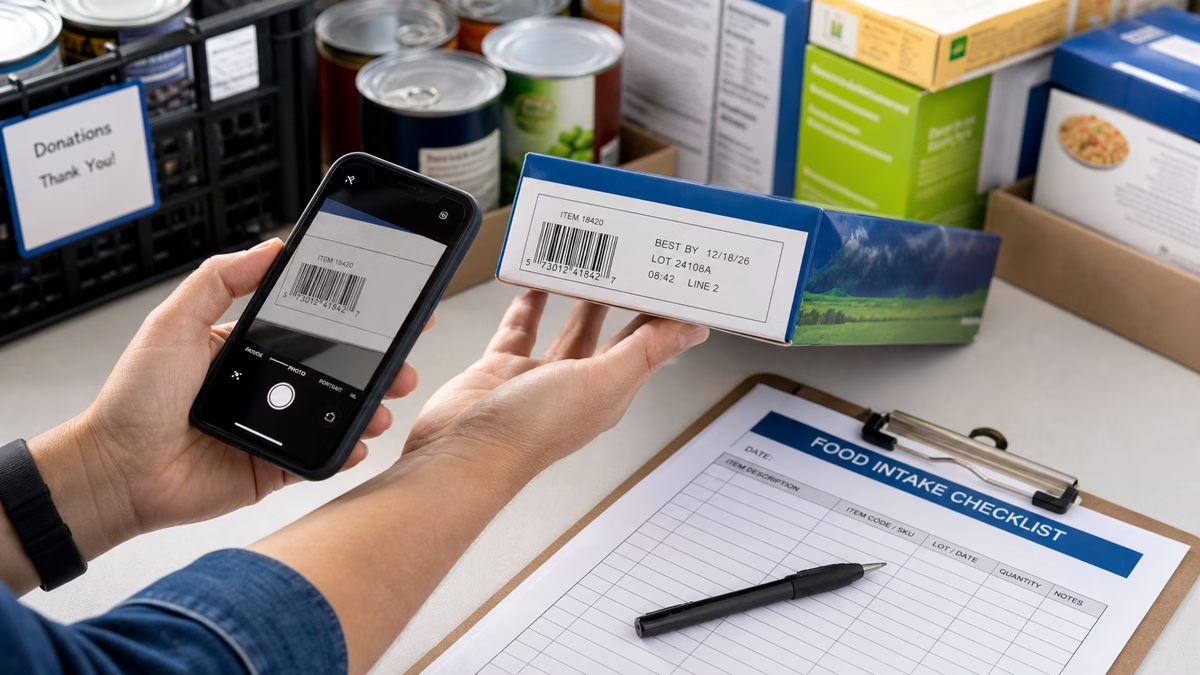
A product name or package color is rarely enough to decide whether a recall notice applies. At intake, record the identifying details that are visible and relevant to the pantry’s process. Depending on the product and the notice, these may include:
- brand and product name;
- package size or count;
- UPC or other product code;
- lot, batch, establishment, or production code;
- use-by, sell-by, best-by, or freeze-by date;
- donor source and intake date.
Do not invent a value when a code is absent, damaged, or unclear. Photographing the package panel can be more reliable than hurried transcription, provided the pantry’s privacy and record-retention rules allow it. The record only needs enough detail for the assigned reviewer to compare the package with an official notice and document the decision.
The exact identifiers vary from notice to notice. Some notices focus on a lot and date range; others list package sizes, establishment numbers, distribution areas, or other marks. The reviewer should compare every identifier named in the specific notice rather than relying on a generic list.
Use Recall Search as Discovery, Then Read the Official Notice
The federal sources do not all cover the same products or publish information in the same way. The FDA recalls and safety alerts page lists certain recalls of FDA-regulated products and explains that its press-release list is not complete. The USDA FSIS recalls and public health alerts portal is the direct place to review FSIS notices. FoodSafety.gov recalls and outbreaks brings recent FDA and USDA notices together and links to the responsible agencies.
A consolidated food recall search can help a pantry reviewer discover a possible match by product, brand, or notice terms. Treat that result as a lead, not the final instruction. Open the responsible agency or manufacturer notice, confirm that the package matches all listed details, and follow the current directions in that notice.
Keep two limits visible in the workflow:
- No search result is not proof that an item is acceptable. Recall databases do not replace the pantry’s rules for condition, date labels, donation eligibility, or handling history.
- A similar name or image is not a confirmed match. The exact product details in the official notice must be compared with the item in hand.
If the notice or product identity remains unclear, the volunteer should stop the intake decision and refer the item to the person named in the pantry’s policy. That may be a pantry coordinator, partner food bank, supplier contact, or local food-safety authority.
Create a Clear Hold-and-Review Path
An intake volunteer should not have to solve every uncertain case alone. The written process should explain when an item goes on hold and what happens next. Common triggers might include a possible notice match, unreadable identifying information, damaged packaging, uncertain temperature history, or another condition already defined by the pantry or partner food bank.
Place a held item in the location designated by the pantry’s policy and mark its status so it cannot be confused with ready inventory. Record:
- the item and visible identifiers;
- the date and reason for the hold;
- the notice URL or search terms reviewed, when applicable;
- the volunteer or lead responsible for the next decision;
- the eventual outcome and date.
Do not taste, open, or repackage an uncertain item to investigate it. Do not discard, return, or distribute a confirmed recalled product based on a summary alone. Follow the handling or remedy directions in the current official notice and the pantry’s approved procedure.
The word “hold” should describe an internal status, not imply that the pantry has made a regulatory finding. It simply keeps an unresolved item out of normal circulation while the designated reviewer gathers enough evidence to decide the next step.
Keep Recall Status Separate From Other Acceptance Questions
A recall check answers one narrow question: whether the available identifiers match a known notice. It does not answer every question about a donation. Pantries may also need separate rules for:
- damaged, leaking, swollen, rusted, opened, or otherwise compromised packaging;
- missing ingredient or allergen information;
- date-label acceptance;
- refrigerated or frozen products with uncertain temperature history;
- homemade foods, repackaged goods, or products outside the program’s donation policy;
- local or partner-food-bank requirements.
Those criteria should come from the pantry’s own approved policy and applicable guidance, not from an improvised recall checklist. A package can have no matching recall and still be ineligible for distribution. Conversely, a broad brand-name match does not establish that a particular package is recalled when its listed identifiers differ.
This separation is valuable in broader church mission planning. It lets leaders assign training, records, and decision authority to the right people instead of asking every volunteer to interpret safety guidance independently.
Build a Shift Handoff That Preserves the Evidence
Rotating volunteers create a predictable risk: an unresolved item can lose its context between shifts. A brief handoff closes that gap. Before the intake volunteer leaves, the incoming volunteer or lead should be shown:
- which items remain on hold;
- why each item was held;
- which notice or source has already been checked;
- what question remains unanswered;
- who owns the next action.
The handoff can be a paper log, shared spreadsheet, or entry in the pantry’s inventory system. Avoid unnecessary personal information. Use role names or initials if that matches the organization’s record policy, and keep any donor details only as long as the program requires them.

A Practical Pantry Recall-Check Checklist
Use this list as a starting point for a pantry-specific procedure:
- Route new packaged-food donations to the designated intake area.
- Keep received, ready, and held items visibly distinct.
- Record the product details that are legible and relevant.
- Search by exact product terms rather than package appearance alone.
- Open the responsible agency or manufacturer notice for a possible match.
- Compare every identifying detail listed in that notice.
- Treat an empty search as unresolved evidence, not a safety verdict.
- Follow the pantry’s separate rules for condition, dates, allergens, temperature, and donation eligibility.
- Place uncertain items on hold according to the approved procedure.
- Record the source checked, the remaining question, and the next owner.
- Follow the exact current notice and local policy for a confirmed match.
- Include all open holds in the shift handoff.
Make the Routine Easy to Repeat
The strongest intake routine is not the most complicated one. It is the one volunteers can repeat, leads can audit, and the next shift can understand. Post the short checklist at the intake point, keep official-source links in the lead’s reference sheet, and review the process after a real hold to see where instructions were unclear.
That approach supports both service and stewardship. It does not promise that a search can certify a donation as safe. Instead, it gives a church pantry a disciplined way to preserve product details, find authoritative information, pause uncertain decisions, and hand the evidence to the right person.




0 Comments